Muhurat trading 2026: how it works, what people trade, and the dos and don'ts
A friendly guide to Diwali's short Muhurat session: exact timings, how traders usually take part, and the simple dos and don'ts that keep it a celebration.
In this article
Happy Diwali! Today, Sunday 8 November 2026, the NSE and BSE open for Muhurat trading, a short special session that marks the start of Samvat 2083, the new Hindu financial year. For many families it is as much a tradition as lighting diyas: open the trading app, place one small, meaningful trade, and begin the year with a good intention.

This guide covers how the session works, what people usually trade, and the dos and don'ts that keep it a celebration instead of a stress. It is a guide for learning, not a list of tips.
Muhurat trading in one minute
- What it is: a short, special session held on Diwali (Lakshmi Pujan). "Muhurat" means an auspicious time.
- When: the main Muhurat trading session runs from 2:20 pm to 3:30 pm (IST), after a pre-open from 2:05 pm. The full timetable is below.
- Why people take part: for luck and tradition. Many investors see the first trade of the Samvat as a blessing for the year ahead.
- Is it a normal market? Yes and no. Orders are real, trades settle in the usual way and charges apply. But the session is short, and far fewer people take part.
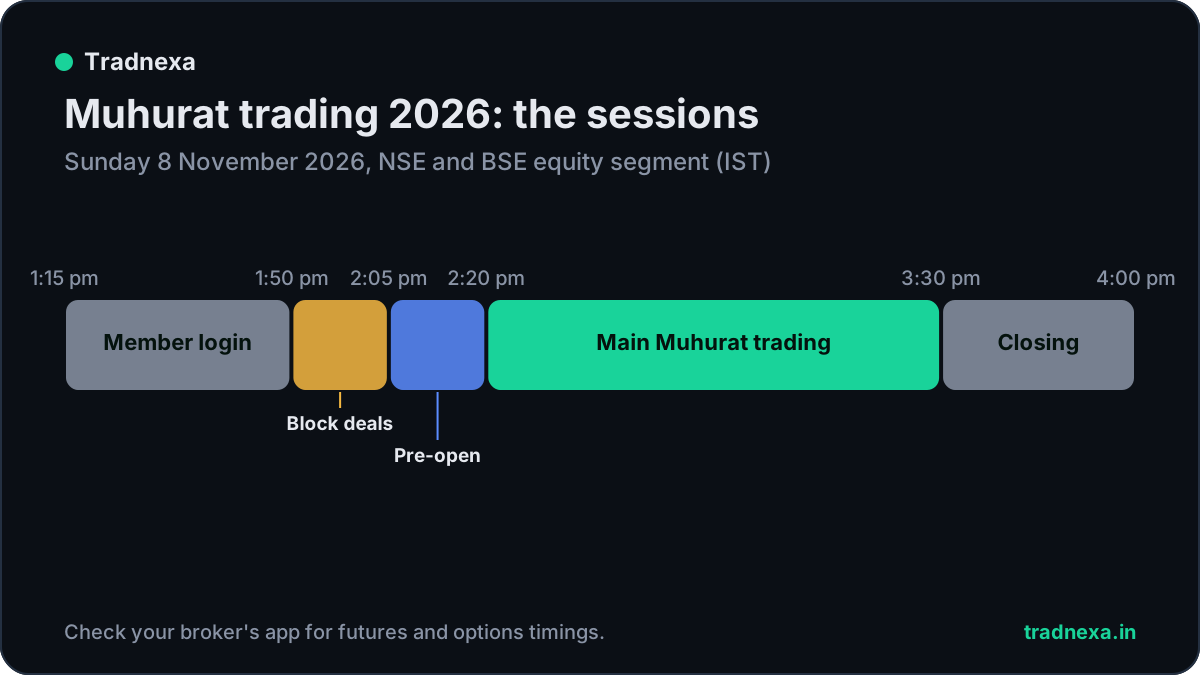
Muhurat trading 2026 timings (NSE and BSE, equity)
| Session | Time (IST) |
|---|---|
| Member login | 1:15 pm to 1:50 pm |
| Block deal session | 1:50 pm to 2:05 pm |
| Pre-open session | 2:05 pm to 2:20 pm |
| Main Muhurat trading | 2:20 pm to 3:30 pm |
| Closing and price display | up to 4:00 pm |
What these mean, in plain words:
- Member login: brokers connect to the exchange. Nothing trades yet.
- Block deal session: a window for very large trades between big institutions.
- Pre-open: orders are collected and matched to find a fair opening price. You can place orders now; they fill at the opening price.
- Main session: normal buying and selling, the part most people mean by "Muhurat trading".
- Closing / price display: closing prices are worked out and shown.
These are the equity segment timings. Futures and options can differ slightly, so check your broker's app or the NSE / BSE circular before 2 pm.
How to take part, step by step
- Log in early. Open your broker app before 2 pm. Apps are busy on Muhurat day, and logins can be slow.
- Check your funds and holdings. Make sure the money is in your trading account. If you want to sell shares, check with your broker whether shares bought on Friday can be sold today.
- Decide before the bell. Pick what you want to do, and how much, before trading starts. Seventy minutes go fast.
- Use limit orders. A limit order lets you set the highest price you will pay (or the lowest you will accept). In a thin, fast session it protects you from a surprise price.
- Place your trade, then step back. One calm trade is the tradition. Then go and enjoy the evening with your family.
What do people usually trade?
There is no "Muhurat stock". What people trade depends on their own goals, and this section describes common habits, not recommendations. Nothing here tells you what to buy.
A token investment for the long term
The most common Muhurat habit is a small purchase in a company or fund the person already knows well and plans to hold for years. The idea is symbolic: "I start the year by adding to something I believe in." The amount is usually small.
Index funds and ETFs
Some people prefer to start the year with an ETF (exchange traded fund: a basket of shares that trades like one share) that follows an index such as the Nifty 50. It spreads one small purchase across many companies.
Gold ETFs and gold bonds
Gold is part of Diwali, and many investors buy a little of it in digital form, through gold ETFs, instead of jewellery or coins.
Intraday trading and F&O
Some active traders do trade intraday or futures and options in the session. This is where the short session and low volume matter most, so read the dos and don'ts below carefully.
The dos
Do keep it small and symbolic
The tradition is about a good start, not a big bet. Many people choose an amount they would be happy to see go down without worrying.
Do plan your trade the day before
Decide what, how much and at what price before 2 pm. Write it down. When the session opens, you only have to follow your own plan.
Do use limit orders
With fewer buyers and sellers, the gap between the best buy price and the best sell price (the spread) can widen. A limit order keeps your price under your control.
Do check timings, settlement and expiry
Confirm the session times, whether your Friday purchases can be sold, and when your broker squares off intraday positions (many do it earlier than usual on this day). Because of the Diwali holidays, F&O expiry calendars show the next Nifty weekly expiry on Monday, 9 November, so check the exchange calendar before trading derivatives.
Do look at the bigger picture
If you like charts, open the Nifty chart on the weekly (1W) timeframe. The week before Diwali was one of the strongest for Indian shares in years, as our post on Nifty's best week since 2021 explains. The weekly picture tells you more than one short session on a Sunday ever can.
The don'ts
Don't treat it as a lucky day for big profits
Muhurat trading is auspicious by tradition, not by statistics. Prices can go up or down in the session like any other day, and the next day too.
Don't use borrowed money or big leverage
Leverage (trading with borrowed money or margin) multiplies both gains and losses. In a thin, fast session, it can turn a small move into a big loss.
Don't use market orders in thin volume
A market order buys or sells at whatever price is available right now. When few people are trading, "right now" can be a surprisingly bad price.
Don't trust "Muhurat tips" from strangers
Messages promising a "special Diwali stock" or "assured gains" on WhatsApp or Telegram are a red flag. Real research doesn't come with a countdown. If someone guarantees returns, walk away.
Make the new Samvat a better trading year
A good year usually comes from small daily habits, not one lucky session: a plan for every trade, a fixed amount you are willing to risk, and a trading journal. On Tradnexa you can follow the market on live charts, set price alerts so you don't have to watch the screen all day, and see the Bullish, Bearish or Neutral bias of the Nifty, Bank Nifty and Sensex with its reasons in Institutional NexaScan.
If you are new to futures and options, start with our guide to open interest before the next expiry.
From all of us at Tradnexa: Shubh Deepavali. May the new year bring you calm decisions, steady learning and plenty of joy at home.
FAQ
What time is Muhurat trading on 8 November 2026?
In the equity segment, the pre-open runs from 2:05 pm to 2:20 pm and the main Muhurat session from 2:20 pm to 3:30 pm (IST), with closing and price display up to 4:00 pm. Futures and options timings can differ slightly, so check your broker's app or the NSE / BSE circular.
Are Muhurat trades real trades?
Yes. Orders placed in the session are real, settle in the normal way, and the usual brokerage, taxes and charges apply.
Is Muhurat trading a good time to make money?
It is a tradition, not a signal. Volume is lower than a normal day, so prices can move sharply on small orders. Many people place a small, symbolic trade and keep it simple. Whether to trade at all is your own decision.
Should I use market orders or limit orders in the session?
Limit orders are usually the safer choice in a short, thin session, because they let you control the price you pay or receive. A market order can fill at an unexpected price when few people are trading.
When is the next Nifty weekly expiry after Diwali?
F&O expiry calendars show it on Monday, 9 November 2026, moved because of the Diwali holidays. Always confirm on the exchange's expiry calendar before trading derivatives.
Sources
For education only. Not investment advice. Tradnexa is not a SEBI-registered investment adviser or research analyst. Trading in crypto, futures and options carries a high risk of loss; past moves don't predict future ones. Read our risk disclaimer.