Nifty's best week since 2021 and Muhurat trading 2026: what happened and how to read it
Nifty and Sensex rose about 8.6% in a week, the most since February 2021, before Sunday's Muhurat trading. What drove it and how to read the chart.
In this article
Indian shares just had their strongest week since February 2021. The Nifty 50 rose about 8.6% and the Sensex about 8.8% in the week to Friday, 6 November 2026, according to several weekly market reviews. On Friday alone the Nifty gained 493.75 points (2.01%) to close at 25,030.35, and the Sensex added 1,718.01 points (2.17%) to 81,028.02.

And the market isn't done with the festive calendar yet: Muhurat trading, the special one-hour Diwali session, is on Sunday, 8 November 2026, the start of Samvat 2083.
This post explains what drove the week, what Muhurat trading actually is, and how to read a week like this on a chart without getting carried away.
Education only. For Indian indices Tradnexa shares a Bullish, Bearish or Neutral bias and never buy or sell calls, levels or targets.
The week in numbers
| Detail | Figure (week to 6 Nov 2026) |
|---|---|
| Nifty 50 close | 25,030.35 |
| Sensex close | 81,028.02 |
| Nifty weekly change | about +8.6% |
| Sensex weekly change | about +8.8% |
| Winning streak | 7 sessions in a row (to Friday) |
| Investor wealth added | about ₹28.7 lakh crore (reported) |
Different outlets round the weekly percentages slightly differently (some headlines say "9%"). The closing levels above match across reports.
What drove the rally
Reports point to the same handful of reasons.
1. Foreign investors came back
FIIs (foreign institutional investors: overseas funds that buy Indian shares) had been steady sellers for much of the year. That changed from late October, and reports say their buying picked up again this week. When large foreign funds buy, they usually buy the biggest index stocks, so the Nifty and Sensex feel it first.
2. Crude oil fell
India imports most of its oil, so cheaper crude helps on several fronts: lower import costs, less pressure on the rupee and on inflation, and better margins for many companies. Several reports name easing crude prices as a key reason for the rally.
3. Earnings and banks
Quarterly results season is on, and reports say bank and financial stocks led Friday's gains. Banks carry a large weight in both the Nifty and the Sensex, so when they move together, the indices move a lot.
4. Festive mood
Friday was Dhanteras, and Diwali is this weekend. Festive optimism is hard to measure, but it showed up in headlines all week.
What is Muhurat trading?
Muhurat trading is a short special session that the NSE and BSE hold on Diwali (Lakshmi Pujan). It marks the start of the new Hindu financial year, Samvat. This year it opens Samvat 2083.
Many traders and investors place a small, symbolic trade in this session for good luck. It is a tradition, not a signal.
2026 timings
Brokers' notes based on the exchange circular say:
- Date: Sunday, 8 November 2026
- Pre-open: from about 2:05 pm
- Normal trading: from 2:20 pm, for about an hour
Brokers give slightly different closing times for equity and for futures and options, so check your broker's app or the NSE / BSE circular for the exact close.
Things that work differently
- Short session, thin volume. One hour of trading means fewer participants, so prices can jump more than usual on small orders.
- Settlement rules still apply. Trades settle normally, so check with your broker whether shares you bought on Friday can be sold in the Muhurat session.
- Intraday positions are squared off earlier than usual by many brokers. Check yours.
- Expiry moves. Because of the Diwali holidays, the next Nifty weekly expiry has moved to Monday, 9 November, per F&O expiry calendars. Check the exchange calendar before trading derivatives this week.
How to read a week like this on a chart
A big week can look exciting. Here is how to look at it calmly, without turning it into a prediction.
Look at the weekly candle, not just the daily ones
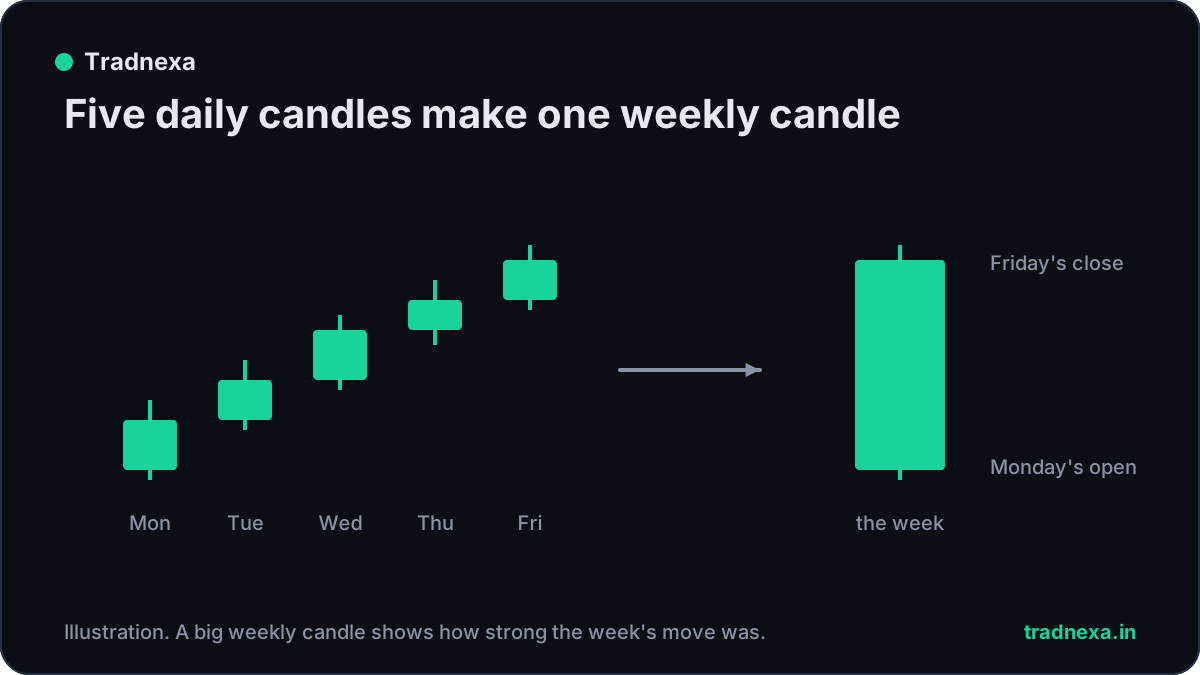
Switch the Nifty chart to the weekly (1W) timeframe. A week like this one usually prints a long green candle with a small upper wick (the thin line above the body). That shape says buyers were in control from Monday's open to Friday's close. Then compare it with the last few months of candles: was this week a break from a sideways range, or one more step in an existing trend? That context matters more than the size of the candle.
Streaks are information, not instructions
Seven up days in a row doesn't happen often. A streak tells you momentum is strong right now. It does not tell you how long it lasts. Strong streaks can continue, pause sideways or reverse; looking at volume and breadth (how many stocks are rising, not just the index) gives a fuller picture.
Check whether the move is broad
If only a few heavyweight stocks lift the index, the rally is narrow. If most stocks rise with it, it's broad. Institutional NexaScan on Tradnexa shows the Nifty, Bank Nifty and Sensex bias with its reasons, including breadth of the index's own stocks, so you can see whether the move is widespread.
Watch the derivatives side
Open interest and the put-call ratio help you see how traders are positioned around a big move. If you're new to them, start with our guides: open interest explained and why Nifty's PCR looks different everywhere.
Treat Muhurat candles with care
The Muhurat session prints a short, low-volume candle on the daily chart. On intraday charts it is one hour of data on a Sunday. Don't read too much into its size or direction; it is better seen as part of the bigger weekly picture.
What to watch next
- FII flows: whether foreign buying continues after the festive week.
- Crude oil: a rebound in oil prices would remove one of the week's main supports.
- Results: more quarterly results are due, especially from banks and large companies.
- Global cues: US markets, interest rates and the dollar still matter for flows into India. Our explainer on the Fed's hawkish hold covers why.
- The economic calendar: for data and events that can move markets next week.
Details for some of these may still change as more data comes in.
FAQ
Why did the Nifty rise so much this week?
Reports point to foreign investors buying again, a fall in crude oil prices, strong quarterly results led by banks, and festive optimism around Dhanteras and Diwali. Together they gave the Nifty its best week since February 2021.
When is Muhurat trading in 2026?
On Sunday, 8 November 2026, the start of Samvat 2083. Brokers' notes based on the exchange circular say normal trading starts at 2:20 pm after a short pre-open, and runs for about an hour. Check your broker or the NSE / BSE circular for the exact closing time.
Is Muhurat trading a good time to trade?
It's a short, symbolic session with lower volume than a normal day, so prices can move sharply on small orders. Many people place a small token trade for tradition. Whether to trade at all is your own decision; nothing here is advice.
Does a seven-day winning streak mean the rally will continue?
No. A streak shows strong momentum at that moment, but it says nothing certain about the next day or week. Look at the weekly chart, volume and how broad the move is to understand it better.
When is the next Nifty weekly expiry?
F&O expiry calendars show it moved to Monday, 9 November 2026 because of the Diwali holidays. Always confirm on the exchange's holiday and expiry calendar before trading derivatives.
Sources
- Upstox: Market weekly wrap: SENSEX jumps 6,568 pts, NIFTY50 rallies 9% as FIIs return
- Zee Business: Sensex, Nifty surge 9% in best weekly rally since Feb 2021; Muhurat trading in focus
- HDFC Sky: Sensex jumps 8.82% to 81,028, Nifty reclaims 25,000 in best week since 2021
- Business Standard: Nifty reclaims 25K as rally extends to 7th day; Sensex up 1,718 pts (6 Nov 2026)
- ETV Bharat: Sensex settles above 81,000; Nifty reclaims 25,000 (6 Nov 2026)
- Kotak Neo: FII buying returns as lower crude and strong earnings lift Nifty hopes
- Upstox: Muhurat Trading 2026: key dates, time and full schedule
- Anand Rathi: Muhurat Trading 2026: date, timing and rules
- Geojit: What is Muhurat Trading? Time and details (2026)
- Quantsapp: F&O expiry calendar 2026
- MarketHolidays.in: F&O expiry calendar 2026 (next Nifty expiry Mon 9 Nov)
For education only. Not investment advice. Tradnexa is not a SEBI-registered investment adviser or research analyst. Trading in crypto, futures and options carries a high risk of loss; past moves don't predict future ones. Read our risk disclaimer.