FII DII data 17 Nov 2026: FIIs buy ₹4,195 crore of shares but stay short in index futures
FIIs bought ₹4,195 crore in cash on 17 Nov while holding just 33% long in index futures. FII, DII, Pro and retail positions explained simply.
In this article
Foreign institutional investors (FIIs) bought a net ₹4,195.38 crore of Indian shares on Tuesday, 17 November 2026, and domestic institutions (DIIs) added ₹196.93 crore, according to provisional exchange data. That is about ₹4,392 crore of combined institutional buying, the second strong day for FIIs in a row. Yet the futures and options (F&O) data tells a more careful story: FIIs hold only one long index future for every two short ones.
The Nifty 50 closed at 25,387.40, up 96.30 points (0.38%), and Bank Nifty rose 1.13% to 62,273.25. India VIX, the market's fear gauge, eased slightly to 15.52. Tuesday was also the Nifty weekly expiry, which explains the very large drop in option positions you will see below.
Cash market: where the money went
The cash market is plain buying and selling of shares. These are the provisional figures exchanges publish after the close (final numbers come a day later and can change slightly):
| Group | Net in cash market (₹ crore) |
|---|---|
| FII / FPI | +4,195.38 |
| DII | +196.93 |
| Combined | +4,392.31 |
On Monday, 16 November, trackers reported FIIs at about +₹4,865 crore and DIIs at about −₹3,519 crore. So FIIs have now bought for two sessions running, while DIIs swung from selling to small buying. When FIIs buy in size, it usually supports large-cap stocks such as banks, which fits Bank Nifty's stronger day.
F&O positions: what the big players hold
NSE publishes participant-wise open interest every evening. It splits every open futures and options contract into four groups:
- FII: foreign institutions
- DII: Indian institutions (mutual funds, insurers)
- Pro: brokers' own trading desks
- Client: everyone else, mostly retail traders
If the term open interest is new to you, our open interest guide explains it in two minutes.
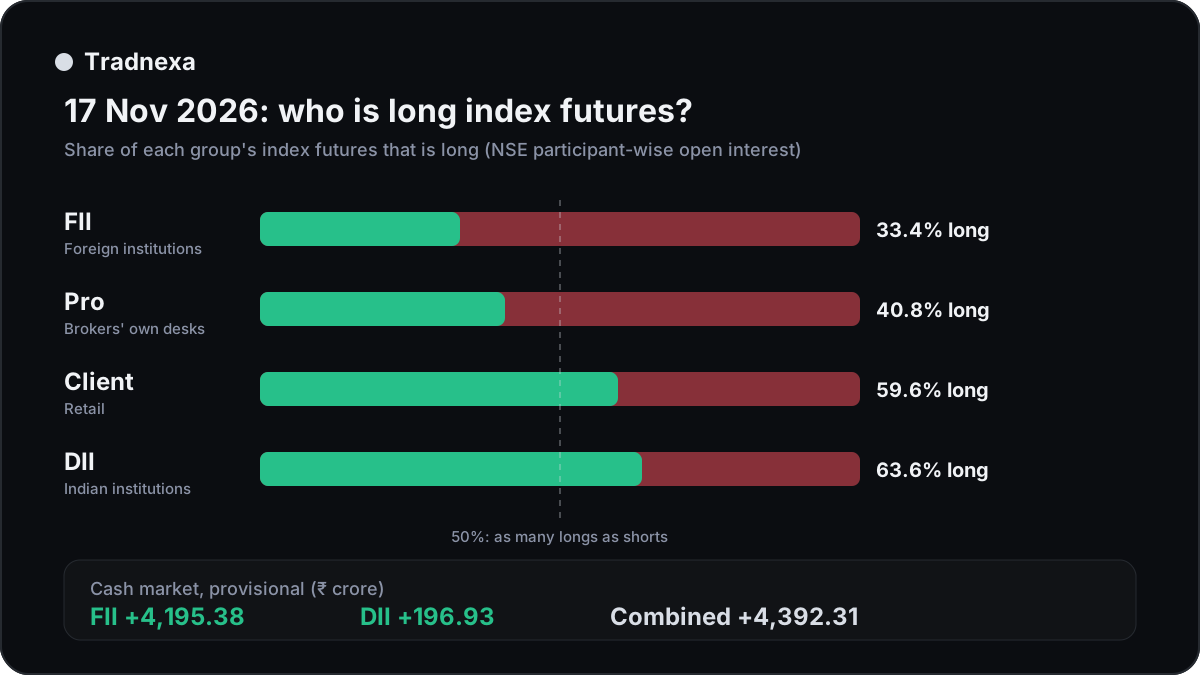
Index futures: FIIs still heavily short
| Group | Long | Short | % long | Net change today |
|---|---|---|---|---|
| FII | 65,568 | 1,30,691 | 33.4% | −8,436 |
| Pro | 28,628 | 41,538 | 40.8% | +11,251 |
| Client | 1,70,907 | 1,15,613 | 59.6% | −3,090 |
| DII | 53,126 | 30,387 | 63.6% | +275 |
FIIs added 4,529 long contracts and 12,965 short contracts in index futures on Tuesday. Their net position fell from about −56,700 to −65,123 contracts, and their long share slipped from 34.1% to 33.4%. Three days ago (13 November) it was 34.6%, so the drift is small but steady.
Professional desks moved the other way: they closed 7,805 shorts and added 3,446 longs, lifting their long share by about 7 points to 40.8%. Retail traders stayed the most bullish group in futures at around 60% long.
Index options: expiry-day clean-up, FIIs keep their protection
Because it was expiry day, huge numbers of option contracts simply ended. Retail traders alone closed about 15 lakh call contracts on each side (bought and sold), and similar numbers of puts. Big moves like these on an expiry day are normal and say little on their own.
The more useful number is what each group still holds:
| Group | Index calls (bought − sold) | Index puts (bought − sold) |
|---|---|---|
| FII | −1,16,830 | +3,69,613 |
| Pro | +88,282 | −1,37,652 |
| Client | +23,684 | −3,45,115 |
| DII | +4,864 | +1,13,154 |
Read it like this:
- FIIs hold far more puts than they have sold. A put gains when the market falls, so this works like an insurance policy. It is common for funds that have bought shares in cash to protect them with puts, so it does not mean FIIs expect a fall.
- FIIs are net sellers of calls (−1.17 lakh), though less than on Monday. Selling calls earns the premium when the market does not rise sharply.
- Retail traders are net put sellers (−3.45 lakh), the mirror image of FIIs. In simple terms, a good part of the protection FIIs buy is sold to them by retail traders.
For how the put-call ratio is built from these numbers, see our Nifty PCR explainer.
Stock futures: FIIs long, DIIs hedged
In single-stock futures, FIIs are net long about 9.84 lakh contracts and added both longs (28,347) and shorts (21,988) on the day. DIIs are net short about 39 lakh stock futures, which is normal: mutual funds and insurers own large share portfolios and use stock futures mainly to hedge them, not to bet on a fall.
Putting it together: what the data says
Here is the picture in plain words:
- Cash flows lean positive. Two days of strong FII buying in shares, and DIIs back to small buying.
- FII index futures lean negative. At 33.4% long they are still clearly short, and they added more shorts than longs on Tuesday.
- FII options look like hedging. Large put holdings next to cash buying usually mean protection, not a bet.
- Professional desks covered shorts, a small positive.
- Retail is the most bullish group, as it often is.
So the signals are mixed. Our NexaScan Big Players reading for FII positioning stays Bearish (it looks only at FII index futures and options), while the cash flow picture is supportive. Overall we would call the institutional mood Neutral: buying shares, but keeping a hedge on.
What to watch in the next few sessions
- Whether the FII long share in index futures starts to climb back above 40%. That would show the cash buying turning into confidence.
- Whether FII cash buying continues for a third day, or fades.
- Whether DII flows stay positive, since they have often balanced FII moves this month.
This is a description of positions, not a forecast. Open interest shows what is held at the close, not why, and one day of data can be noisy, especially on an expiry day.
You can see these numbers update every evening in the Big Players tab of Institutional NexaScan, with a 10-day chart of FII and retail positioning. Our earlier FII, Pro and retail breakdown shows how to read the same tables step by step.
FAQ
What were the FII and DII figures on 17 November 2026?
Provisional exchange data showed FIIs as net buyers of ₹4,195.38 crore and DIIs as net buyers of ₹196.93 crore in the cash market, about ₹4,392 crore combined. Final figures are published a day later and can differ slightly.
If FIIs bought shares, why are they short in index futures?
Funds often hold shares and hedge them at the same time. Shorting index futures or buying puts protects a share portfolio if the market falls. So FIIs can be net buyers in cash and still hold more short than long index futures.
What does "FII 33% long in index futures" mean?
Of all the index futures contracts FIIs held at the close, 33% were long (gaining if the index rises) and 67% were short. Below 45% is usually read as bearish positioning, above 55% as bullish.
Why did option open interest drop so much on 17 November?
17 November was the Nifty weekly expiry. Contracts that expire are removed from open interest, so very large "closed" numbers on an expiry day are normal and not a sign of panic.
Where can I see this data every day?
NSE publishes the participant-wise open interest file each evening after about 6 pm. Tradnexa's Institutional NexaScan shows it in the Big Players tab, updated automatically every evening and again before the market opens.
Sources
- NSE: Participant wise open interest in equity derivatives (17 Nov 2026)
- NSE: Participant wise open interest in equity derivatives (16 Nov 2026)
- NSE: Participant wise trading volume in equity derivatives (17 Nov 2026)
- NSE: FII/FPI and DII trading activity, provisional (17 Nov 2026)
- Quantsapp: FII DII data (16 Nov 2026)
- StockEdge: FII DII provisional cash market activity
For education only. Not investment advice. Tradnexa is not a SEBI-registered investment adviser or research analyst. Trading in crypto, futures and options carries a high risk of loss; past moves don't predict future ones. Read our risk disclaimer.