FII vs Pro vs Retail: what today's FII/DII and F&O data says about Nifty (11 Nov 2026)
FIIs bought ₹12,563 crore of shares, yet in options they sold the calls retail traders bought. FII, Pro and retail positions made simple, plus our verdict.
In this article
Foreign funds (FIIs) poured about ₹12,563 crore into Indian shares on Wednesday, 11 November, a big day of buying. But the futures and options (F&O) data tells a more careful story: retail traders rushed to buy call options, while FIIs and professional traders quietly sold those calls and FIIs bought put options as protection.

So who is right? Below we break the day's data into plain words: who bought, who sold, who is betting up and who is betting down. Then we give our verdict on what the numbers are saying.
First, who are FIIs, DIIs, Pros and Retail?
Every day after the market closes, the NSE publishes how four groups of traders are positioned. Knowing who they are makes the numbers easy:
- FIIs (Foreign Institutional Investors): big overseas funds. They move huge amounts of money, so the market watches them most closely.
- DIIs (Domestic Institutional Investors): Indian mutual funds, insurance companies and pension funds. Your monthly SIP money flows through them.
- Pros (Proprietary traders): brokers and trading firms that trade with their own money. They are usually experienced F&O traders.
- Retail (called "Clients" in NSE data): individual traders like most of us.
A simple rule of thumb many traders use: FIIs and Pros are the "smart money" in F&O, and retail is often on the other side. That is not always true, but it explains why traders compare the three.
The cash market: FIIs bought big, DIIs sold
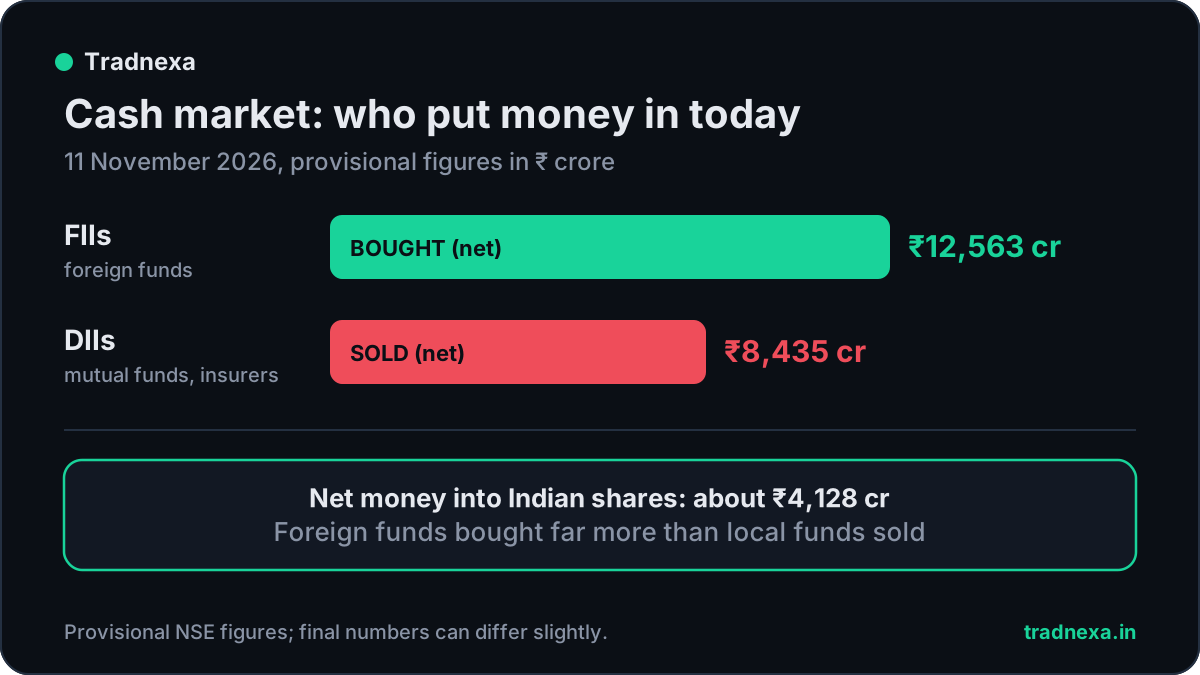
In the normal share market (called the cash market), the provisional NSE numbers for 11 November were:
| Group | What they did | Amount |
|---|---|---|
| FIIs | Bought more than they sold | ₹12,563 crore |
| DIIs | Sold more than they bought | ₹8,435 crore |
| Net | Money flowing in | about ₹4,128 crore |
This fits the bigger picture. FIIs have been net buyers through November so far, according to monthly and weekly flow trackers. Their return was a major reason Nifty and Sensex just had their best week since February 2021, rising about 9%.
DIIs selling on a strong day is common: mutual funds often book profits into a rally. Strong FII buying is the most bullish piece of today's data.
These are provisional figures. Final numbers can differ slightly.
Index futures: FIIs are still betting down, but less
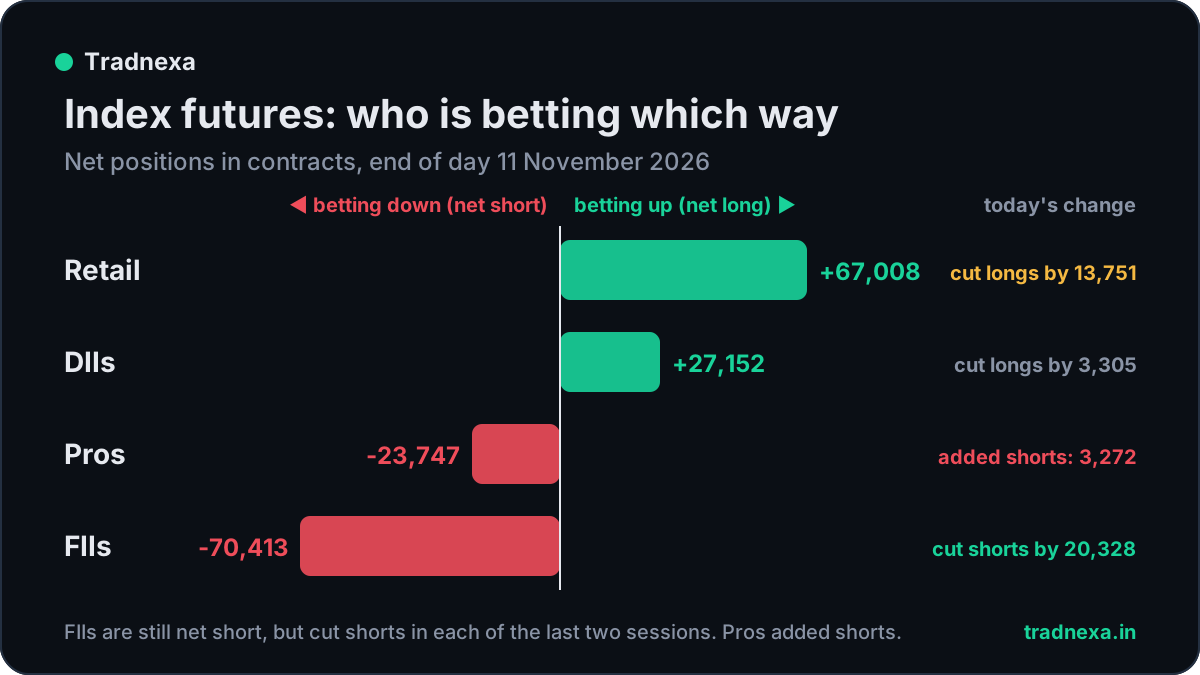
Index futures are contracts on Nifty and Bank Nifty. A net long position is a bet that the index rises; a net short is a bet that it falls. Here is where each group stood at the end of the day (in contracts):
| Group | Net position | Change today | In plain words |
|---|---|---|---|
| Retail | 67,008 long | 13,751 fewer longs | Still bullish, but booked some profit |
| DIIs | 27,152 long | 3,305 fewer longs | Mildly bullish |
| Pros | 23,747 short | 3,272 more shorts | Turning more cautious |
| FIIs | 70,413 short | 20,328 fewer shorts | Still bearish, but covering fast |
The key number is the FII one. Two sessions ago FIIs were short about 1,01,459 contracts. Today it is about 70,413. They have cut roughly 31,000 short contracts in two sessions. When big players close shorts, they have to buy futures back, and this short covering often adds fuel to a rally.
Even so, FIIs are not bullish on index futures yet. Of all the index futures contracts FIIs hold, only about 31% are longs and 69% are shorts. Many traders watch this long-short ratio: a move towards 50% or above would show FIIs actually turning positive.
Index options: retail chased calls, FIIs and Pros sold them
Options are where today's data gets interesting. A quick refresher:
- Buying a call is a bet that the index will rise. Selling (writing) a call is a bet that it will not rise much.
- Buying a put is a bet on a fall, or insurance against one. Selling a put is a bet that it will not fall much.
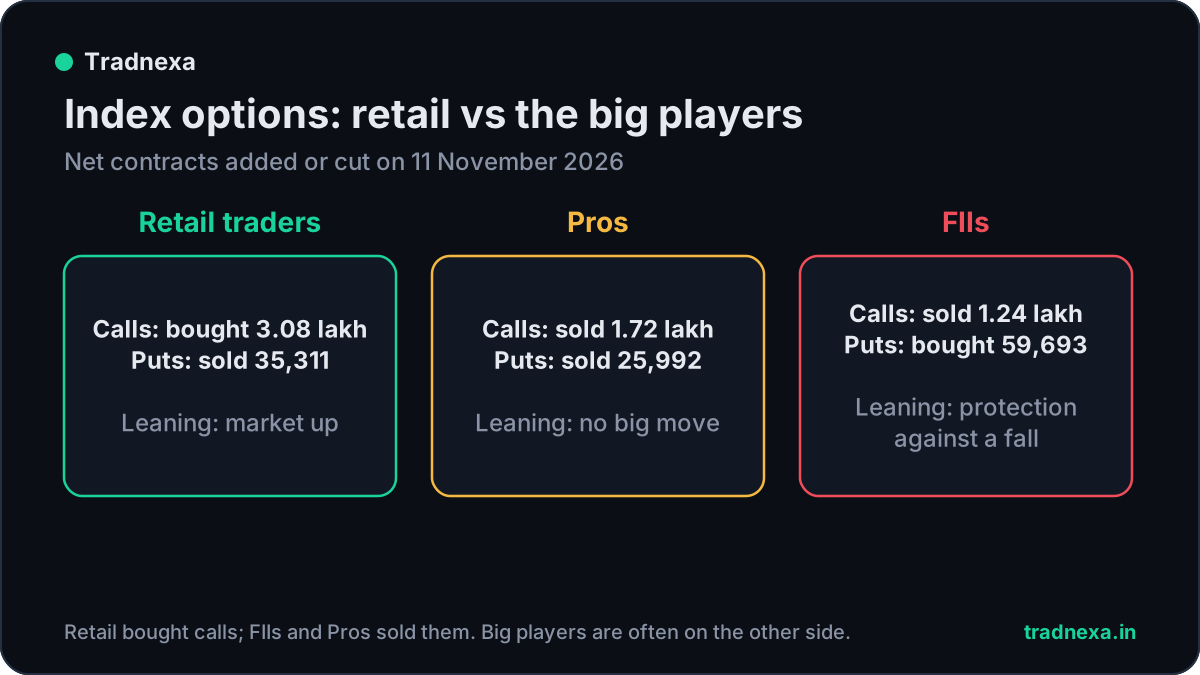
Here is what changed in net index option positions today:
- Retail: bought about 3.08 lakh call contracts and sold about 35,311 puts. Both are bullish bets. Retail is clearly expecting more upside.
- Pros: sold about 1.72 lakh calls and about 25,992 puts. Selling both usually means they expect the market to stay in a range and collect the option premium.
- FIIs: sold about 1.24 lakh calls and bought about 59,693 puts. That reads as hedging: they bought shares in cash, and bought protection in case the market falls.
In simple words: retail bought the calls, and the big players sold them. When retail is this one-sided, many traders see it as a warning that the easy part of the move may be done.
One caution about this data: option contracts are counted as raw numbers, so a cheap far-away option and an expensive near one count the same. That is why the direction of change matters more than the exact size.
The other clues: PCR and the red candle
- PCR (put-call ratio) about 0.81: below 1 means more calls are open than puts. On Tradnexa's NexaScan, a PCR below 1.00 reads as a Bearish tilt. Our PCR explainer shows how to read it.
- A red candle at the top: Nifty ended higher than its previous close but below where it opened, after a 9% week. We covered what that means in red candle at the top: reversal or pullback.
Our verdict: what is the data saying?
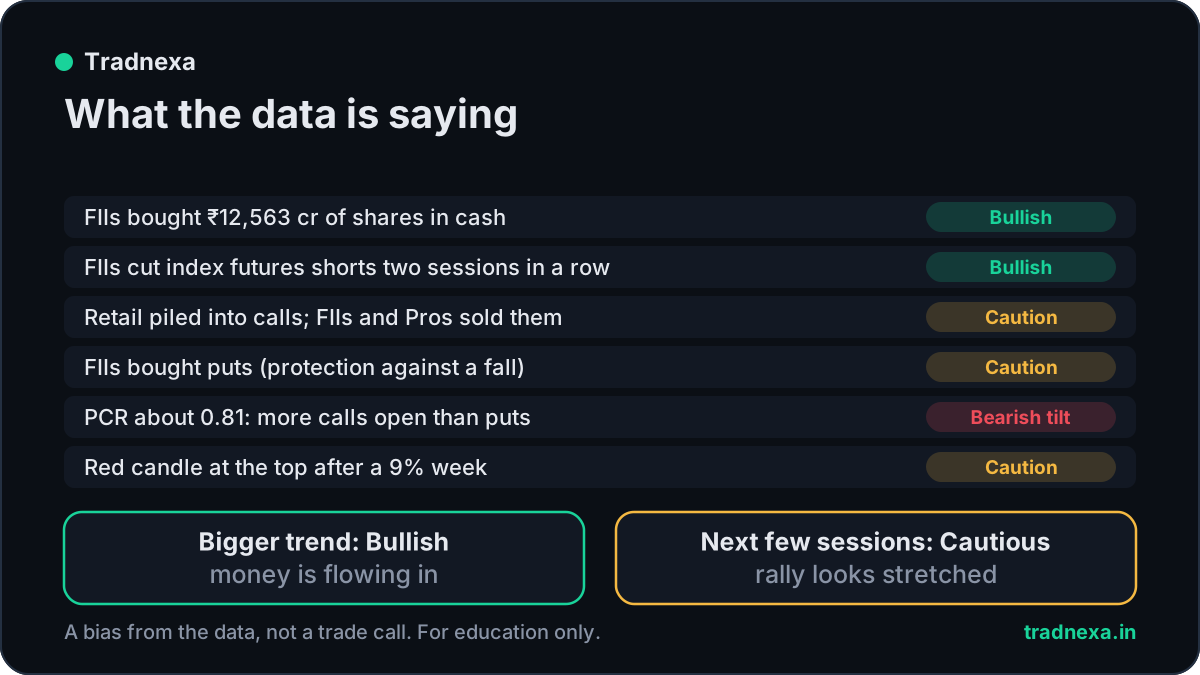
Putting it all together:
Bigger trend: Bullish. Money is flowing in. FIIs bought heavily in cash, and they are steadily closing their index futures shorts. That is the kind of support that rallies are built on.
Next few sessions: Cautious. The rally looks stretched. Retail is piling into calls, FIIs and Pros are on the other side, FIIs are buying puts, the PCR is below 1, and the day left a red candle at the top. Together these point more towards a pause, a sideways phase or a pullback than a straight run higher.
What would change this view:
- More bullish: FIIs keep covering shorts and their long ratio climbs towards 50%, while cash buying continues.
- More bearish: FIIs start adding index shorts again, keep buying puts, or turn sellers in cash.
This is a bias from the data, not a trade call. After a big rally, decide your risk before you trade, keep position sizes sensible, and avoid chasing one-sided moves. You can watch Nifty's Bullish or Bearish bias live with the Magic Line on our free charts.
FAQ
What is FII and DII data?
It shows how much foreign institutional investors (FIIs) and domestic institutions such as mutual funds (DIIs) bought and sold in Indian shares that day. The NSE publishes provisional figures every evening. Net buying by FIIs is usually read as positive for the market.
What is participant-wise open interest?
It is NSE's daily report of how FIIs, DIIs, Pros and retail traders (Clients) are positioned in futures and options. It shows whether each group is net long (betting up) or net short (betting down) in index futures, calls and puts.
Why do traders watch FII positions in index futures?
FIIs trade very large sizes, so their bets can move the market. When FIIs cut shorts (short covering), they buy back futures, which can push prices up. When they add shorts, it can weigh on the market.
Why is retail buying calls seen as a warning?
When retail traders crowd into one side, such as buying calls, and FIIs and Pros take the other side, it often means the move is already well known. Big players selling those calls are betting that the market will not rise much further in the near term. It is a caution sign, not a certainty.
Is the market bullish or bearish after 11 November 2026?
Our read of the data: the bigger trend is Bullish because FIIs are buying in cash and covering index shorts. The next few sessions look Cautious because the options data is one-sided, the PCR is below 1 and the day left a red candle at the top.
Sources
- NSE: FII/FPI and DII trading activity, provisional (11 Nov 2026)
- NSE: Participant wise open interest, F&O daily reports (11 Nov 2026)
- Business Standard: Stock Market LIVE, Sensex gains 397 pts, Nifty at 25,130 in closing auction session (11 Nov 2026)
- Tapetide: FII and DII flows in November 2026
- Stockpil: FII vs DII this week (6 Nov 2026)
- Upstox: Market weekly wrap, SENSEX jumps 6,568 pts, NIFTY50 rallies 9% as FIIs return
- Zee Business: Sensex, Nifty surge 9% in best weekly rally since Feb 2021
For education only. Not investment advice. Tradnexa is not a SEBI-registered investment adviser or research analyst. Trading in crypto, futures and options carries a high risk of loss; past moves don't predict future ones. Read our risk disclaimer.