Jensen Huang quits Nvidia, Bitcoin slips below $72,000: what traders should watch
Nvidia's CEO resigned without warning, US inflation ran hot and Bitcoin fell to its lowest since August. What happened, why it is linked and what to watch.
In this article
The man who built the world's most valuable chip company walked out on Thursday, and Bitcoin fell with the market. Jensen Huang resigned as Nvidia's chief executive on 12 November 2026 with immediate effect, Nvidia shares dropped by double digits during the day, and Bitcoin slipped below $72,000 for the first time since August. Here is what happened, why a chip company's boss can move a coin, and what to watch next.
What happened at Nvidia
Nvidia told regulators in a filing that Huang has stepped down as CEO and left the board. Chief financial officer Colette Kress will run the company as interim CEO while keeping her finance job, until the board picks a permanent successor.
Huang co-founded Nvidia and led it for more than three decades. Under him, Nvidia's chips became the engine of the AI boom, which is why its share price is watched by almost every market in the world.
Why did he leave? Nvidia did not give a reason. News reports link the exit to allegations about his personal life, including a reported relationship that US authorities are said to be looking into. These are allegations in press reports, not proven findings, and details are still coming out.
How the stock reacted: Nvidia shares fell more than 10% in early US trading on Thursday (some reports put the low near 14%) before recovering part of the drop.
What happened to Bitcoin
Bitcoin fell below $72,000 on 12 November, trading around $71,000 to $71,800 at its low, its weakest level since August. A few other numbers tell the story of the week:
| What | Roughly how much |
|---|---|
| Crypto positions forced shut (liquidated) in 24 hours | More than $650 million, mostly bets on a rise |
| Money taken out of US spot Bitcoin ETFs | About $1.4 billion over five sessions |
| Total crypto market value lost since October's highs | About $550 billion |
A liquidation happens when a trader borrows to bet on a price (leverage) and the price moves against them so far that the exchange closes the position automatically. When many traders bet on a rise at once, a fall triggers a chain: forced selling pushes the price lower, which forces more selling.
Important context: Bitcoin was already falling for weeks before Thursday. Huang's exit did not start the slide. It added a sharp push to a market that was already nervous.
The second shock: hot US inflation
A day earlier, US consumer prices for October rose 0.4% in the month, more than the 0.3% economists expected. Core inflation (prices without food and energy) rose 0.3% for the third month running.
That matters because the US Federal Reserve (the Fed) raises interest rates to cool prices. After the data, traders priced a December rate hike as the most likely outcome, with a smaller chance of a bigger, half-point move. The Fed meets on 8 and 9 December.
Higher interest rates usually make investors less keen on risky assets. Cash and bonds start paying more, so the money that chased growth stocks and crypto has a reason to sit still. For more on how the Fed moves Bitcoin and Nifty, read our post on the Fed's hawkish hold.
Why a chip company's boss can move Bitcoin
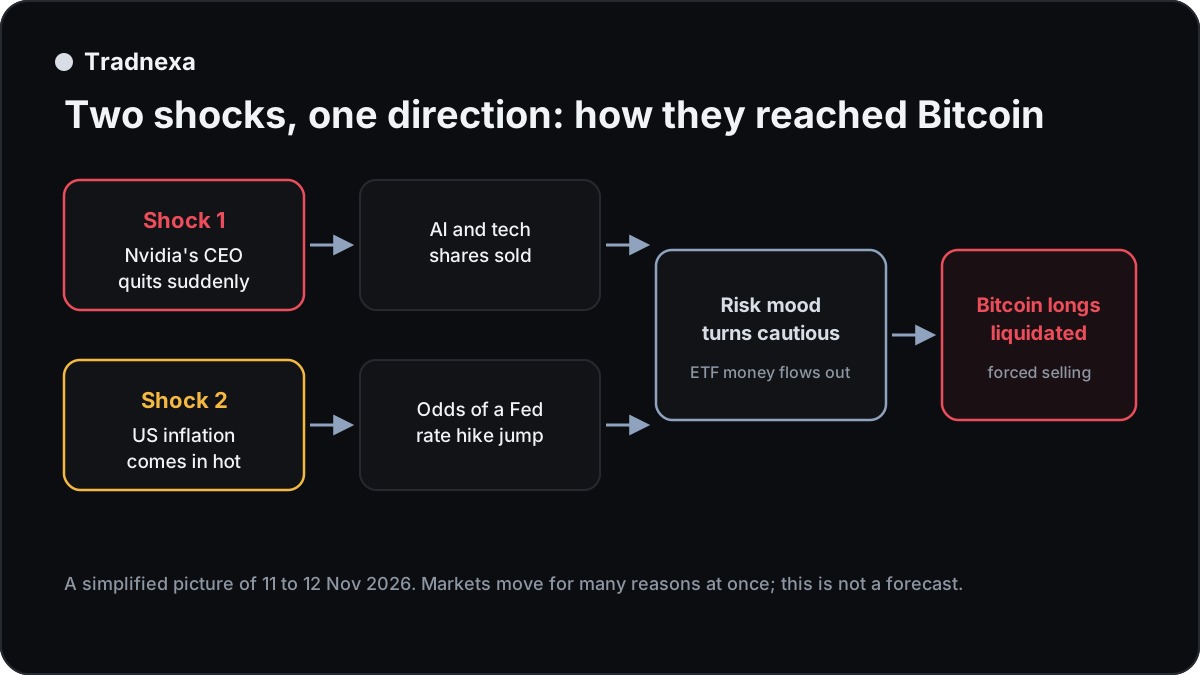
Bitcoin and big tech shares are often owned by the same kind of investor: funds and traders who like growth and risk. When one of the market's most important companies suddenly loses its leader, those investors cut risk everywhere, not only in Nvidia.
There is also a direct link. Several Bitcoin mining companies have turned part of their power and buildings into AI data centres, so their shares now move with the AI trade as well as with Bitcoin. When AI shares fall, these miners fall too, and that hurts the mood around crypto.
Put the two shocks together and they point the same way: a sudden worry about the AI boom, and the chance of higher US rates. Neither one alone explains every dollar of the fall, but together they explain why selling came fast.
What it means for Indian traders
On Friday morning, GIFT Nifty (the Nifty futures contract traded at GIFT City before India opens) pointed to a weaker start for Indian shares, as global markets digested Thursday's news.
The overall mood is cautious (neutral to bearish) for the opening, but India is not an AI chip market. A few things to keep in mind:
- IT stocks sell technology services to US companies. They can move with US tech sentiment, but they don't make chips, so the link to Nvidia is indirect.
- Foreign investors (FIIs): if global funds cut risk, they can sell Indian shares too. Some analysts argue India could instead attract money as a market that is less exposed to AI, so watch the daily FII figures. Our FII and DII data explainer shows how to read them.
- The rupee and US rates: a likely Fed hike can strengthen the dollar, which tends to weigh on emerging markets like India.
This is a bias for the day, not a call. Markets often calm down once the first shock is priced in.
How it shows up on a chart
If you open a Bitcoin chart on the 1-hour or 4-hour timeframe, a few things stand out after a move like this:
- Long red candles with big volume, the footprint of forced selling (liquidations).
- A price that broke below a level it had held for weeks. Round numbers like $70,000 often attract attention because many traders watch them.
- Wicks (thin lines) below the candles if buyers start to step in. Long lower wicks after a liquidation wave often mean the forced selling is drying up, but they are not a promise of a turn.
The Magic Line on Tradnexa charts (an ATR-based trend line) helps you see whether the trend has flipped or the move is only a pullback: a close below it marks the bearish side, and the line itself shows where the trend would change.
What to watch next
- Who will lead Nvidia: news on a permanent CEO could calm or shake the AI trade again.
- Nvidia's results, expected soon, will show whether the business is still growing as fast.
- Bitcoin ETF flows: a pause in outflows would suggest big holders have finished selling.
- The Fed on 8 and 9 December, and any US data before it.
- Liquidation totals: if they fall while the price steadies, the forced selling may be over.
FAQ
Why did Jensen Huang resign from Nvidia?
Nvidia did not give a reason. News reports connect his exit to allegations about his personal life, which are not proven. CFO Colette Kress is interim CEO while the board looks for a permanent leader.
Why did Bitcoin fall when Nvidia's CEO quit?
Many investors own both big tech shares and crypto. A shock to the AI leader made them cut risk across the board. Bitcoin was already falling for weeks because of ETF outflows and hot US inflation, and leveraged traders were then forced to sell.
What is a crypto liquidation?
When a trader borrows money to bet on a price and the price moves too far against them, the exchange closes the position automatically. Many liquidations at once can push prices down very fast.
Will this affect Nifty?
It can affect the mood. GIFT Nifty pointed to a weaker start on Friday, and foreign investors may cut risk. But Indian markets don't depend on AI chips, so the effect is usually indirect and can fade once the news is priced in.
Is Bitcoin a buy after falling below $72,000?
We don't give buy or sell advice. Watch how the price behaves around big round numbers, ETF flows and liquidation totals, and decide with your own plan and risk limits.
Sources
- SEC: NVIDIA Corp Form 8-K, NVIDIA announces CEO transition (12 Nov 2026)
- CNBC: Nvidia CEO Jensen Huang resigns, live updates (12 Nov 2026)
- Al Jazeera: Why did Nvidia CEO Jensen Huang resign, and who is Colette Kress? (12 Nov 2026)
- Fox Business: Colette Kress named Nvidia interim CEO as Jensen Huang's abrupt resignation raises investor concerns (12 Nov 2026)
- Decrypt: Jensen Huang resigns as Nvidia CEO, with CFO Colette Kress named interim chief (12 Nov 2026)
- Business Standard: Jensen Huang quits as Nvidia CEO amid affair, spy allegations: what we know (13 Nov 2026)
- 24/7 Wall St.: Bitcoin fell to $71,800 after Nvidia CEO Jensen Huang resigned (12 Nov 2026)
- CryptoSlate: Bitcoin plunges to $71k as Jensen Huang abruptly resigns (12 Nov 2026)
- The Crypto Times: Bitcoin falls below $72K as ETFs record $1.44B outflows in 5 days (12 Nov 2026)
- Bitcoin.com News: Bitcoin price breaks below $72K as $656M liquidation hits crypto (12 Nov 2026)
- Brave New Coin: Bitcoin loses $72K as $550B vanishes from cryptocurrency market (12 Nov 2026)
- CBS News: Inflation remained elevated in October, CPI report shows, upping odds of Fed interest rate hike (11 Nov 2026)
- InvestmentNews: October CPI comes in hot, raising odds of a bigger-than-expected rate hike (11 Nov 2026)
- Upstox: GIFT NIFTY futures hint towards weak opening on November 13 (13 Nov 2026)
- Business Standard: Stock Market LIVE, GIFT Nifty down 100 pts (13 Nov 2026)
For education only. Not investment advice. Tradnexa is not a SEBI-registered investment adviser or research analyst. Trading in crypto, futures and options carries a high risk of loss; past moves don't predict future ones. Read our risk disclaimer.